

HISTORY OF
THE OFFICIAL SUPPORTERS CLUB
Supporting Shrewsbury Town since 1950
The history of Shrewsbury Town Official Supporters’ Club is closely intertwined with the history of Shrewsbury Town Football Club itself.
For more than 75 years, generations of volunteers have given their time, energy and enthusiasm to support the Town – raising money, improving facilities, bringing supporters together and helping the football club through both good times and difficult ones.
Much of the history recorded on this page comes from an article written by Barry Davies, one of the OSC’s longest-serving and most dedicated members, who sadly passed away in 2025.
Barry's memories provide a wonderful first-hand account of an era when the Supporters’ Club played an enormous part in life at the Gay Meadow. This history is dedicated to Barry and to the many volunteers who served alongside him.
The beginning – 1950
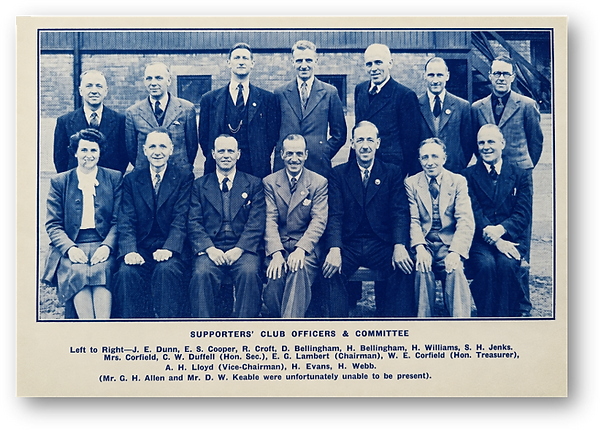
The origins of the Official Supporters’ Club can be traced back to 1950 – the same year Shrewsbury Town entered the Football League.
In April that year, well-known local newsagent and lifelong Town supporter Edwin Gregory offered £100 towards a fund to support the club if Shrewsbury were elected to the Football League, provided his contribution could be matched by 24 others.
From those beginnings came a fundraising organisation which would play a hugely important role in supporting the football club for decades.
Early officials included E. Bate as Chairman and W. Corfield as Treasurer, alongside representatives of the Chamber of Commerce, the Licensed Victuallers Association and the Supporters’ Club.
Helping to build the Gay Meadow
The Supporters’ Club didn't simply follow the team – its members quite literally helped to build and improve its home.
Under Chairman Cecil Duffill, the Supporters’ Club was responsible for terracing at the Technical College End of the Gay Meadow, which became known as the Cecil Duffill Terrace. (The Stone Plaque still resides in the back garden of one of the new houses built there.)
Over the following decades, money raised by supporters contributed towards numerous improvements at the ground.
These included covered accommodation on the Riverside, the half-time scoreboard and clock, office furniture and fittings, decorating, equipment for the groundsmen and even the fitting out of a new gym for the players.
The OSC helped purchase mowers, rollers, wheelbarrows, line markers and goal nets, while the new gym was equipped with weights, scales, ropes, a treadmill, mats and benches.
It was supporters helping their football club in the most practical way possible.
Fundraising – Shrewsbury style
For many years the Official Supporters’ Club was one of the football club's principal sources of fundraising.
And its members certainly knew how to raise money.
There were Derby and Grand National draws, programme sales, food and drink from the Gay Meadow buffets and the wonderfully named “Penny on the Ball.”
Penny on the Ball involved numbered tickets being sold around the ground. Counterfoils went into a large blue drum and were drawn at half-time. The first winner received the match ball and the second a cash prize – an early forerunner of the matchday draws supporters would become familiar with in later years.
Then there was the enormous Christmas Draw.
Tickets were sold throughout Shropshire and around 150 prizes were donated each week. On draw night, volunteers gathered at Shrewsbury Music Hall. Some wrote out winning slips, others put them into envelopes, another group added the stamps, before two volunteers drove everything to the sorting office at Castle Foregate.
Remarkably, many winners would receive the good news in the post the following morning.
Nearly 4,000 members
The scale of the Supporters’ Club during this period is perhaps best demonstrated by its membership. In July 1960, the OSC announced a record membership of 3,951.
By then it had already donated £14,200 towards ground improvements and the purchase of a house for players. The Supporters’ Club also agreed to provide the football club with a £3,000 interest-free loan.
These were considerable sums of money at the time and demonstrate just how important the supporters were to the development of Shrewsbury Town.
Supporters across Shropshire
The idea of bringing Town supporters together beyond Shrewsbury itself isn't a new one. The OSC developed a network of local branches across Shropshire.
There were branches at Ford, Wem, Baschurch and Ludlow, with the network later expanding to include Madeley, Ironbridge and Church Stretton.
These weren't simply informal groups. Branches had their own committees, produced accounts and presented their balances and fundraising cheques at meetings of the main Supporters’ Club.
It is a tradition of bringing supporters together which remains just as relevant to the OSC today.
Life behind the scenes at the Gay Meadow
Barry joined the Supporters’ Club committee in 1964. His first committee included Chairman Dennis Bellingham, Secretary Fred Brown and Treasurer Stan Jones, alongside Tom Wiggington, Mrs Wiggington, Eddie Griffiths, Albert Durnell, Tom Sargent and Molly Dooley.
There were no executive boxes or modern meeting facilities.
Committee meetings took place in one of three metal-framed corrugated huts beneath the main stand at the Technical College End of the Gay Meadow. The other two were occupied by the Town manager and club secretary.
Annual General Meetings, meanwhile, were often held at the Music Hall in Shrewsbury town centre and could attract around 100 supporters, who gathered to hear reports, examine the accounts, vote and renew their memberships.
Feeding the Gay Meadow
Another enormous part of the OSC's work was running the refreshment buffets.
Four buffets – at the Station End, beneath the Main Stand, the Tech End and later the Riverside – were built using money raised by the Supporters’ Club and staffed by volunteers, their families and friends.
Before the buffets were built, Molly Dooley would walk around the perimeter of the pitch selling sweets and crisps from a wooden tray strapped around her shoulders – rather like the traditional ice-cream sellers once seen in theatres and cinemas.
The buffets subsequently became a significant source of income for the Supporters’ Club and another example of the extraordinary amount of voluntary work taking place on matchdays.
The floodlight fund
In January 1967, the Supporters’ Club launched a special fund to help pay for floodlights at the Gay Meadow.
Chairman Dennis Bellingham brought together representatives of the Supporters’ Club, football club directors, the manager and club secretary.
One of their first decisions was to increase the price of the matchday programme by three old pence, effectively doubling its price, with the aim of raising £500 towards the estimated £12,000 cost of installing the floodlights.
Numerous other events and fundraising activities followed.
£35,000 when Town needed it
Perhaps one statistic demonstrates the importance of the Supporters’ Club during this era better than any other.
During the 1974/75 season, Shrewsbury Town announced a trading loss of £51,681.
That loss was substantially offset by an extraordinary £35,000 in donations from the Supporters’ Club.
It is difficult today to overstate the scale of that contribution.
The OSC wasn't simply organising social events for supporters. Its volunteers were making a significant financial contribution to keeping their football club moving forward.
The first Player of the Year
One tradition which continues to be associated with supporters today was actually the idea of Barry Davies himself.
Before the 1972/73 season, Barry proposed that the Supporters’ Club should organise a Player of the Year award.
After the committee agreed, Barry distributed ballot papers and collected and counted hundreds of votes.
The inaugural winner was Sammy Irvine, with players subsequently receiving their trophies at social evenings at venues including the Music Hall and Tiffany's nightclub.
It became another lasting contribution from the Supporters’ Club to Shrewsbury Town tradition.
Generations of volunteers
The story of the OSC is ultimately a story about people.
Barry remembered many of those who gave their time over the years, including Ralph Clayton, Brian Davies, Graham Hughes, Alan Follmer, Ann Ralphs, Sally Ellis and Dave Harry – while acknowledging that there were many more whose names could never all be recorded.
Barry himself performed numerous roles around the club. As well as his work with the Supporters’ Club, he was the Gay Meadow public-address announcer, announcing team changes and reading out half-time scores from around the country.
Those who remember the Gay Meadow will also remember Barry as a familiar face selling matchday programmes – another small part of the countless hours he devoted to his football club.
Continuing the tradition
The role of a Supporters’ Club has inevitably changed since those early days.
Football has changed. The Gay Meadow has gone. The ways supporters communicate, travel, socialise and interact with their football club have changed beyond recognition.
But the principle at the heart of the OSC remains remarkably similar:
Shrewsbury Town supporters coming together to support their club and one another.
Today's OSC is building on that heritage – bringing supporters together, encouraging new generations to become involved and ensuring that the voice, community and traditions of Shrewsbury Town supporters continue to thrive.
As Barry wrote when reflecting on the organisation to which he had devoted so much of his life, the Official Supporters’ Club had always been “loyal and helpful” to Shrewsbury Town Football Club.
More than 75 years after its beginnings, that remains our ambition.
In memory of Barry Davies
This history has been adapted from an original article researched and written by Barry Davies, one of the longest-serving members of Shrewsbury Town Official Supporters’ Club.
Barry gave decades of service to the OSC and Shrewsbury Town Football Club, and much of what we know about the early years of the Supporters’ Club has been preserved because he took the time to record his memories.
Following Barry's passing in 2025, we are proud to preserve his work here as part of the history of the organisation he served for so many years.
Thank you, Barry.
